
Edited by : Vikram Khaitan
As Indigo 6E-2652 approached the makeshift airport in Prayagraj, my heart swelled with anticipation. This trip was never planned; it wasn’t destined to happen. Just four days earlier, I was hosting guests at a remote resort in Odisha (where I work), over a thousand kilometres away, with no thought of making this journey. Then my phone rang.
When the dates for the Kumbhwere announced, I was disheartened; it coincided with peak tourist season, making it nearly impossible for me to attend this once in a 144 years event. But my wife’s call changed everything. She and five of her colleagues had already booked their flights and hotel. Sensing an opportunity, I proposed tagging along, even offering them a stay in the tent city set up by one of our sister companies. But, as always, my life doesn’t unfold without a little drama.
The first hurdle came when I tried booking a seat on the same flight. It was full. The next available flight was 12 hours later, and they weren’t willing to wait. Undeterred, I secured my ticket for the following morning. Till that point, I hadn’t even applied for leave. I simply texted to my boss: “Leaving the resort for two days for personal reasons, will be back on the 24th.” The response was even shorter: “OK.”
My flight was scheduled to depart from Biju Patnaik International Airport at 6:30 AM, meaning I had to be there by 5 AM. The resort is 160 kilometres from Bhubaneswar, so my plan was to leave after dinner and reach the airport by midnight. But just as I was about to depart, the second challenge struck; a sudden hailstorm battered the tents at the resort. In just 20 minutes, it caused extensive damage, knocking down the front gate and several staff tents. It felt as though nature itself was conspiring to thwart my journey; something longed for, suddenly within reach, only to slip away again like a mirage. The sense of disappointment was palpable, a dull ache of hope dashed. But there was nothing to be done except surrender to the moment, however unwillingly.
Resigned to fate, I cast aside my longing and threw myself into restoring order at the storm-struck resort. The winds had calmed, but my heart was still in turmoil. By 3 AM, the path was finally cleared, and the electricity sputtered back to life. My team, seeing the yearning etched on my face, insisted I go. “You must,” they said, “this trip was written for you.”
And so, at 3:30 AM, with exhaustion tugging at my limbs and hope flickering like a fragile flame, I set off for Bhubaneswar; 160 kilometres of uncertainty stretched before me. Every moment on that road felt like an eternity. My heart pounded with every turn, my breath shallow, eyes darting between the clock and the horizon. I was on edge, each mile a silent prayer whispered into the darkness.
By some miracle, and a well-timed web check-in, I made it. Just in time.
My flight landed in Prayagraj at 8:30 AM. With no luggage to check-in, I breezed through the airport, where a cab was already waiting. The same driver had earlier transported my wife and her colleagues to the boat club. The ride was smooth, except for the last stretch; crowds had already started gathering in massive numbers.
During the Mahakumbh, Prayagraj transforms into a sprawling spiritual universe unlike anything else in the world. The confluence of the Ganga, Yamuna, and the mythical Saraswati—the TriveniSangam—becomes the heartbeat of a colossal operation that welcomes tens of millions of pilgrims from across the globe. And yet, amid this unfathomable sea of humanity, there is an underlying rhythm, a pulse of organized chaos that somehow holds it all together.
The city, already rich in history and culture, becomes an expansive confluence of faith, infrastructure, and devotion forged together by sheer human will. Temporary roads and pathways, specially constructed for the event, fan out like arteries from the riverbanks to every corner of the Kumbh area. Streetlights stretch endlessly along these roads, illuminating the sandy floodplains of the Ganga, which are transformed into vast tent cities, capable of accommodating hundreds of thousands of people.
Gigantic banners bearing spiritual quotes and portraits of saints line every street. Dozens of massive, well-coordinated entry gates demarcate sectors that look like makeshift townships; each complete with police outposts, fire safety vans, water tankers, health clinics, and sanitation facilities. It is nothing short of a miracle of civic planning, executed on an epic scale. More than 300 kilometers of roads are laid, hundreds of kilometers of electric lines installed, and an elaborate drainage system is put in place to handle the waste and runoff.
Sanitation becomes one of the most remarkable achievements of the Mahakumbh. Rows upon rows of mobile toilets are installed, cleaned constantly by thousands of volunteers and workers. Drinking water stations are set up at frequent intervals. Loudspeakers keep pilgrims informed about safety, weather, lost persons, and timings for ceremonial dips.
Accommodation ranges from basic tent clusters to luxurious Swiss cottages with full amenities. There are tent cities run by the government, spiritual ashrams, private groups, and even NGOs;all offering places to stay, langars (community kitchens), medical care, and spiritual discourses. Our own tent was within one of these enclosures, marked by uniformed staff and a fenced boundary, giving a semblance of security and order amid the swelling crowd.
What struck me most, however, was the seamless integration of technology with tradition. From digital wristbands to track lost pilgrims, to drones monitoring crowd movement, and mobile apps providing real-time information on dip schedules and routes; this ancient gathering had found a way to coexist with the digital age without diluting its essence.
And yet, for all the infrastructure, organization, and technology, the most breath-taking feature of Prayagraj during the Mahakumbh is not its engineering marvels; it is the people. Pilgrims from every corner of India and beyond, clad in saffron, wrapped in woollens, barefeet or in rubber slippers, walk with the same purpose. The energy is palpable, the air electric with chants of “HarHarGange” and “Jai Ganga Maiyya.” Holy men walk in groups, their ash-smeared bodies exuding a different kind of intensity. Their ash comes from the cremation grounds, enveloping them, secluding and detaching them from all worldliness. Sadhus debate philosophy under tents, children fly kites under the open sky, and elderly devotees light incense at makeshift altars on the sand.
Even the local residents of Prayagraj seem to dissolve into the larger spiritual identity of the city. Tea sellers, rickshaw drivers, shopkeepers; all appear infused with a sense of purpose, helping, guiding, serving; aware that this event is far bigger than any individual or institution.
In the end, Prayagraj during the Mahakumbh becomes not just a city, but a living, breathing embodiment of devotion on a scale the world rarely witnesses. It is where logistics meet longing, where planning meets prayer, and where the mundane meets the miraculous. It is civilization in service of the sacred. And to be part of it, even for a few days, is to feel something awaken deep within; a sense of awe not just for the divine, but for what humanity is capable of when moved by faith.
My wife, having taken her early morning dip, was waiting to accompany me to the ‘Sangam.’ It is a point of confluence of three rivers, Ganga, Yamuna and Saraswati (now extinct).
We boarded a small hand-rowed dinghy along with six members of a Telugu family from Tirupati. As life jackets were handed out, I voiced my safety concerns, but the boatman reassured me with a simple, “Don’t worry,Jamunaji sab acchakarenge.” Taking his words to heart, I fully embraced the moment.
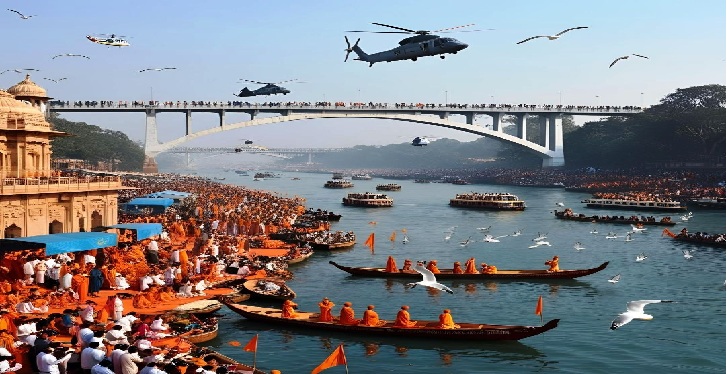
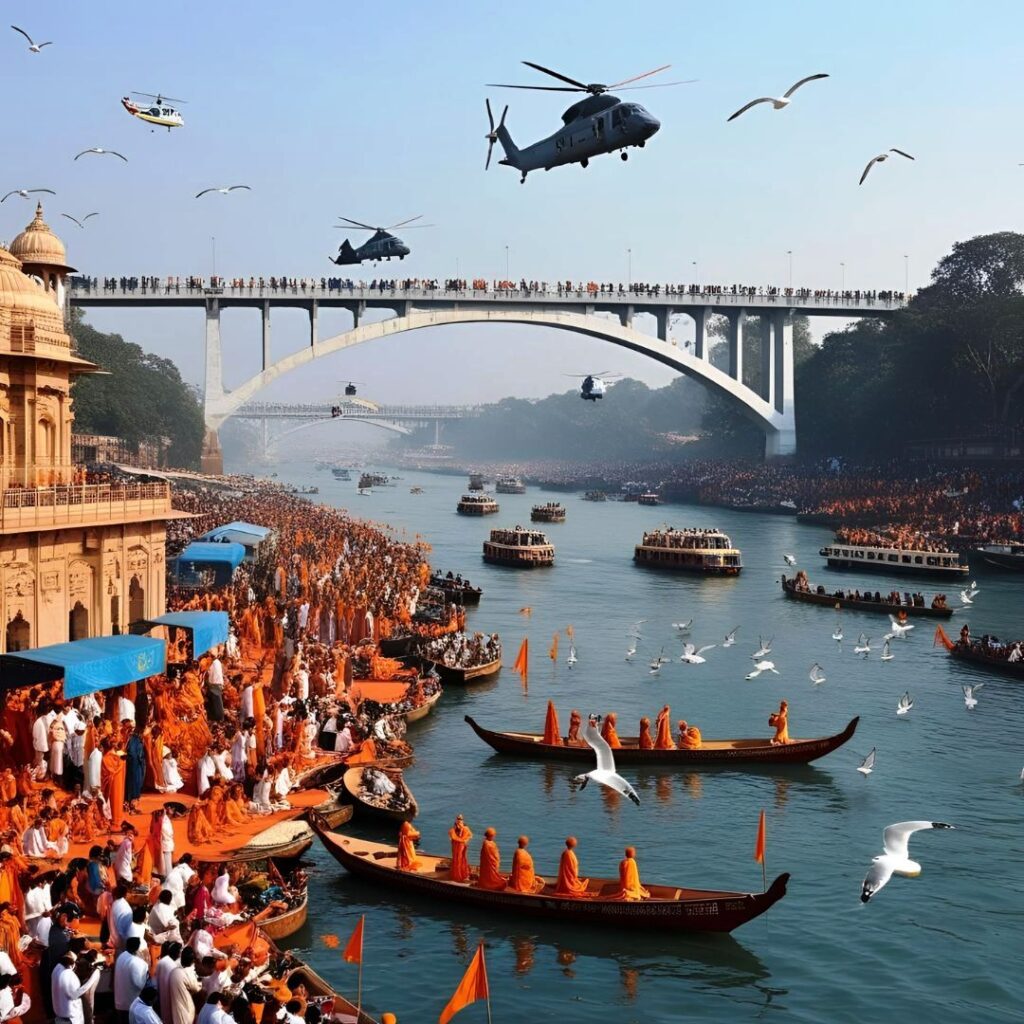
The river was alive. Boats crisscrossed in every direction. The banks teemed with people as far as the eye could see. The sky, too, was a spectacle; helicopters and hovercrafts patrolled overhead. A symphony of sounds filled the air; seagulls crying, devotees chanting kirtans, and water splashing against oars.
Two hours passed in a blur, yet within that blur stirred a tempest of thoughts and emotions. As the boat gently rocked through the sacred waters, my mind teemed with unspoken questions. What would it mean to take a dip in the Mahakumbh? Could the simple act of immersing oneself in water, however holy, truly wash away a lifetime of sins, regrets, attachments, and burdens? I wasn’t there as a ritualist, nor as a thrill-seeker chasing spectacle. I came with a quiet hope for something deeper; a transformation, even if subtle, even if fleeting.
Though I’ve always taken pride in being logical and grounded, I’ve never shunned faith. I am not an atheist. I believe. But my beliefs are tempered with thought, shaped by personal experience rather than inherited dogma. I approach the divine not with blind reverence but with open curiosity. My soul seeks to understand, not just to obey. And yet, here I was, sitting amidst chants, conch shells, and thousands of pilgrims, feeling strangely vulnerable. I had crossed a thousand kilometres, wrestled with storm and uncertainty, just to arrive at this ancient confluence. The questions loomed large: Would I feel anything? Would the river speak to me; not through words, but through silence?
There, in that boat, with the sky glowing faintly with morning light, I wasn’t looking for miracles. I was yearning for a moment of stillness, a sliver of the eternal, a gentle whisper from the divine saying, you are seen, you are heard, and you are held.
When our boat finally docked at the Sangam, the sacred confluence of rivers that had drawn millions from across the country, the crowd was nothing short of overwhelming; a sea of humanity, pulsating with devotion, anticipation, and reverence. Yet, in the midst of that chaos, my focus narrowed. Like a moth drawn to flame, I pressed through the throng with quiet urgency, my heart beating to the rhythm of something far deeper than excitement; it was yearning.
All through the journey, I had imagined this moment in vivid detail. I had rehearsed the prayers I would whisper, the intentions I would offer, the emotions I would surrender. I had hoped for a communion, a moment where time might dissolve and I would feel a surge of the divine sweeping through me. But what happened was far from what I had pictured.
As I stepped into the river and finally immersed myself in its ancient, sacred waters, everything else vanished. The noise, the people, the anticipation; all silenced. Water gushed into my ears and surged over my head, drowning not just the sounds of the world but also the clutter of my thoughts. The moment lasted only seconds, yet it felt like slipping between two realms; the seen and the unseen. There were no flashes of insight, no thunderous revelations. And yet, when I emerged, something had shifted.
I felt light; not physically, but spiritually. It wasn’t the kind of lightness that follows relief or happiness, but the kind that comes from letting go of something unnameable. Expectations, fears, questions; everything had been momentarily washed away. I didn’t find the grand epiphany I had hoped for. What I found instead was something far rarer: silence. A deep, luminous silence within. My mind, usually a restless tide of thoughts and analysis, stood still like the eye of a storm. I wasn’t thinking. I wasn’t feeling. I simply was.
And in that stillness, I understood something subtle yet profound. Spiritual transformation isn’t always a burst of light or a voice from the heavens. Sometimes, it’s the quiet absence of noise. Sometimes, it’s the grace of emptiness, a sacred pause in the inner chatter. And in that pause, I felt touched; not by spectacle, but by presence.
I performed the rituals, offering water to the Sun God and reciting mantras I had known for years. Yet, a deep tranquillity lingered. Even as I boarded the boat for our return, I remained in that thoughtless state, oblivious to the world around me.
It wasn’t until our driver asked for the address of the tent city that I snapped back to reality, like a diver returning to the surface after an immersion into something ancient and otherworldly. The journey that followed; just twenty kilometers from the banks of the Yamuna to those of the Ganga;—stretched into an exhausting seven-hour ordeal. The traffic was relentless, the roads choked with pilgrims and vehicles alike. Yet, not once did I feel the urge to complain.
Outside the window, I watched with awe and quiet reverence as thousands trudged forward on foot; barefoot, weather-beaten, some elderly, some carrying children on their shoulders—all united by a single chant that echoed in waves across the landscape: “HarHarGange!” They had come from every corner of the country, and from across the globe. Some had flown in, some had driven across states, others had clung to crowded train compartments for days, and countless others had simply walked, letting their feet carry their faith across the dusty earth.
In a time when faith is often misrepresented as the dividing line of our civilization and used to polarize, segregate, and stir hatred; what I witnessed at the Kumbh stood as a luminous counterpoint. Here, faith did not divide; it dissolved all boundaries. The distinctions of caste, creed, wealth, gender, and education blurred into insignificance before the flowing might of the river. CEOs stood shoulder to shoulder with daily wage earners. Foreigners recited mantras with locals. Saffron-robed ascetics and corporate-clad travellers all bowed before the same sacred waters. In the eyes of the river, all were equal. All were seekers.
This was not the blind ritualism that critics often scoff at; it was something deeper, something far more human. It was the embodiment of longing, of surrender, of belonging to something greater than the self. The Kumbh was not just a religious event; it was a mirror held up to society, reminding us of our shared fragility, our collective hopes, our desperate search for meaning.
In those seven hours of slow, almost meditative movement from the Yamuna to the Ganga, while the world outside bustled with the ceaseless tide of humanity, my body grew undeniably weary; but something within me remained astonishingly still. There was a quiet centre in me, like the eye of a storm, untouched by fatigue, where peace lingered with soft persistence. And it was in that stillness that something began to take root; a deeper understanding of what faith truly means.
Faith, I realized, in its purest, most uncorrupted form, is not about assertion or identity. It is not a declaration shouted from pulpits or paraded through power. It is not about being right, nor about drawing boundaries between “us” and “them.” True faith does not need to convince. It only needs to connect. And that connection, humble, wordless, and unforced; is what I witnessed unfolding all around me.
I saw it in the eyes of an old woman with cracked heels and silver hair, walking barefoot, murmuring prayers with a tenderness only a lifetime of surrender can bring. I saw it in the quiet patience of a young boy leading his blind grandfather, their hands entwined like roots of the same tree. I saw it in strangers who shared water, food, and stories without ever asking each other’s names. These were not performances of piety; they were echoes of a shared inner longing, a longing to belong, to be held, to touch the divine even if only for a moment.
The river—ancient, eternal, and unjudging; offered no hierarchy, asked no questions. She received all with the same gentle embrace. Whether you came wrapped in silk or rags, with offerings or empty hands, whether your lips formed perfect mantras or awkward murmurs; the river flowed around you with equal grace. In that moment, you were not your status, your gender, your past mistakes, or your future ambitions. You were simply human, fragile, sacred, and seeking.
And perhaps that is the spiritual truth we are all aching to rediscover: that grace does not come to the most devout, but to the most open; not to those who shout the loudest, but to those who simply show up; with sincerity, with humility, with a heart willing to kneel. In a world fractured by noise and ego, this quiet, all-embracing acceptance is the balm we did not know we needed.
As I sat in that car, inching forward while chants rose in waves around me, I felt no impatience. I felt part of something vast and timeless; a river not just of water, but of spirit, flowing through the veins of our collective soul.
I had hoped, after the long and overwhelming day, for a quiet night’s rest; a warm tent, a soft bed, a few hours of sleep to soothe my aching limbs and restore my senses. But as fate would have it, the universe had charted a different course. A simple booking error had left us with only one tent instead of two. And sharing that confined space with five women, however close or familiar, was not an option I could consider.
So, as the rest settled in for the night, I stepped out into the moonlit vastness of the Kumbh, wandered aimlessly, embracing the unknown with a strange sense of surrender. The chill in the air was sharp, the night sky unclouded and endless, and the ghats bathed in a silvery sheen that made the sacred river glow like flowing starlight. I wandered along the banks of the Ganga, wrapped not in wool but in wonder, sleepless yet strangely alert. It was my second consecutive night without sleep, yet I didn’t feel weary. My body might have begged for rest, but my spirit was utterly awake.
All around me, life moved in slow, sacred rhythm. Devotees continued their rituals under the quiet gaze of the stars; some were lighting small lamps and releasing them into the river, the flickering flames drifting like prayers made visible; others stood waist-deep in the icy water, whispering mantras with trembling lips, their faces a blend of agony and ecstasy. The chill didn’t seem to deter them; in fact, it appeared to deepen their devotion. I saw a father guiding his young daughter into the water, both shivering but smiling, their eyes shining with a reverence that no philosophy book could ever explain.
I stood quietly at the edge, watching, absorbing, dissolving.
All the questions I had come with; the logical inquiries of a mind that seeks cause, effect, and rationale, seemed to dissolve in the rising mist of the river. In that moment, surrounded by unwavering faith, my rational mind bowed in quiet humility. What logical framework could possibly measure the intensity of this devotion? What theory could contain the tearful gratitude in someone’s eyes as they folded their hands to the river?
Some things, I realized, are not meant to be understood. They are meant to be felt.
Faith is not always a conclusion reached by reason. Often, it is a journey taken by the heart, through fire, through darkness, through longing, and arriving, breathless, at the shores of surrender. And in that surrender, logic ceases to matter. The heart does not ask why; it only asks how deeply.
That night, lonely, cold, restless, became one of the most sacred nights of my life. I did not sleep, but I dreamt with open eyes. The banks of the Ganga became my silent temple, the river my teacher, and every shivering pilgrim a page from an unwritten scripture.
Some experiences are not to be defined. They are to be lived, just as they are, beyond thought, beyond logic, beyond words.
The next day, we had initially planned a visit to Banaras or Ayodhya, but the traffic made it impossible. While the women explored Prayagraj’s markets to buy souveniers, I caught up on sleep in a hotel near the airport.
Our flight was at 3:30 PM, but given the unpredictable crowds, we left early. The seven-kilometer drive to the airport took two hours. Inside, it was as packed as Mumbai’s central station during rush hour. Our flight, operated by the small airline Allianz Air, struggled to secure a boarding gate. Eventually, we took off at 4:45 PM, reaching Bhubaneswar in two and a half hours. Thus ended my whirlwind journey to the Mahakumbh; an experience that was anything but planned, yet one I will treasure and cherish forever. A trip where I gained nothing but nothingness.